In his own production notes for The Glass Menagerie, Tennessee Williams invites his creatives to employ theatrical tools not to hide from truth, but to edge ever closer to where it exists. The very first lines of this work offer transparency with a speech akin to stage direction, “it is dimly lighted” – “everything seems to happen to music.”
“The play is memory”
When first performed, the extraordinary plaudits for The Glass Menagerie gave Williams his first major success and secured his position alongside Eugene O'Neill and Arthur Miller, as one of the 20th-century’s foremost American playwrights.
Resoundingly autobiographical, rich in symbolism and allusion, the work’s dreamlike step away from realism and conventional story telling saw Williams credited as a theatrical pioneer.
A retrospective examination of a family by the son who left for his own preservation spotlights hope, disappointment, deception, fragility, sentimentality, disability, tradition, obligation, freedom and ultimately, relentless inescapable remorse.
The delivery of truth, like history, sits with the reliability of the witness. Guiding here is Director Mark Wilson who, at times, is a little heavy handed in taking up Williams’ offer to abandon realism given that some of his endeavours to earnestly bridge the eighty-year gap of social sensibility verge on blatant demonstration. Eighty-year-old works are naturally full of outmoded language and ideals and while they may feel twee or uncomfortable, a failure to trust the text to do the lifting infers that an audience might be a tad naïve, but then, given the irritating, baffling and mis placed laughter of so many on opening night, where the fault of interpretation and understanding truly lies, is most definitely a little muddy.
There is immense joy in hearing the beautiful language of one of theatres most superbly crafted works, and revisionism brings with it the opportunity to spotlight themes and ideas that might not have been so possible or pertinent in other times. In the absence of representation, gay people have always looked for themselves on stage and screen and Williams was masterful in knowing just how much light was needed to illuminate the undertones of that space between the lines. Brick, Allan the Grey Boy, Cousin Sebastian and of course Tom here in The Glass Menagerie; Williams’ characters, seen on stage or not, recognisable for clear or strongly inferred homosexuality.
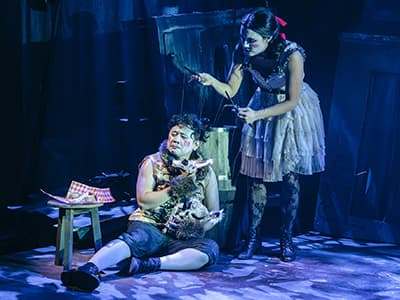
Our first meeting of Tom (of Finland) in this production gives an immediate indication of the freedoms our narrator enjoyed beyond his family home – those ‘trips to the movies’ and ‘tricks’ in his pocket no longer code for the audiences of yesteryear who perhaps had to stifle their sniggering if they were, by chance, in the know. ‘Seeing’ Tom from the outset cleverly amplifies our take on his repression and deeply informs the way we see him in his family dynamic.
Strong here also is the lens brought to disability with Laura being more likely ‘crippled’ by anxiety and neurodivergence than anything else. In recounting their time together at school, gentleman caller Jim O’Connor recalls nothing of the brace on her leg that “clumped so loud” and her seeming ability to walk quite capably when her mother ceremoniously removes it, is indicative of what her environment inflamed and the ease with which the physical could be used to mask and define. When Williams was writing, debilitating mental health could see you institutionalised, lobotomized and deprived of all your teeth and while there was of course no language around neurodivergence, it isn’t hard to imagine that a writer with such extraordinary insight would recognise the placing of a small glass animal into the hands of a trusted other could be interpreted as an act of ‘pebbling’.
Mark Wilson has assembled an extraordinarily strong cast to deliver his vision for this play.
Tim Draxl’s enduring turn in Sunset Boulevard makes him no stranger to directly addressing an audience and while his character’s trajectory is a little less final in this production, the similarities between Tom Wingfield and Joe Gillies are absolutely apparent. Draxl really impresses with his strong and evidently researched choices delivering real freshness and impact to the plays many monologues – familiar to so many theatres school auditionees!
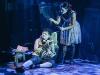
Despite having the least to say, Millie Donaldson as Laura is simply outstanding. In stark opposition to the might and intensity of her mother Amanda, the stillness and reserve she generates allows Laura to appear more misunderstood than unreachable. The choice to keep Laura’s glass menagerie from focus is an incredibly powerful one in that it truly prevents Laura’s existence from veering into tragic and pathetic territory. This really impressive present performance is utterly supported and complimented by Harry McGee as her gentleman caller Jim O’Connor. This is a perfectly measured, truly thoughtful and wonderfully kind performance. The lengthy scene between these two actors, on the floor and in near darkness was beautifully realised and incredibly moving. For two young performers to play at this level is astonishing.
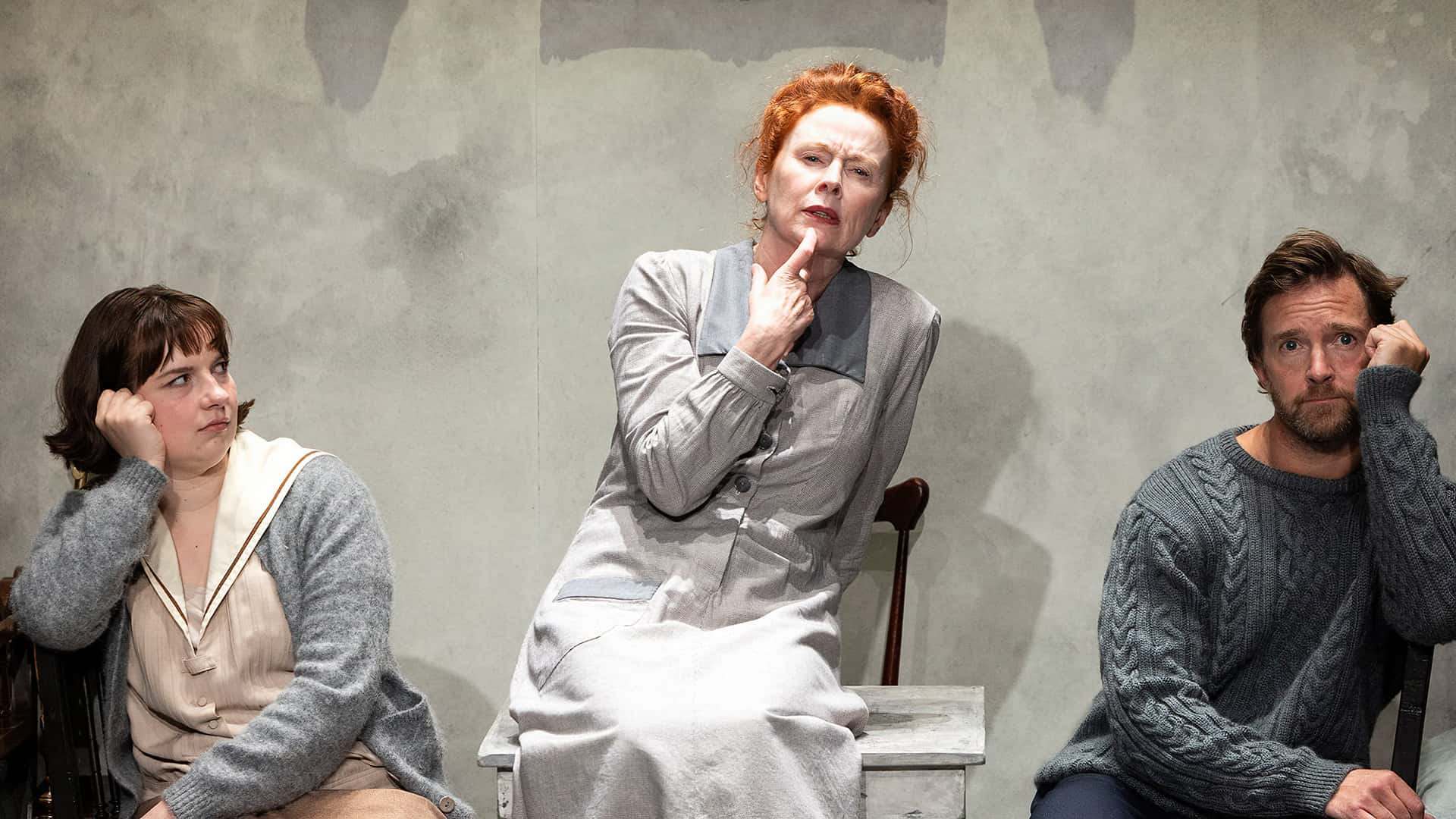
After being so unbelievably good as Linda Lowman opposite Anthony LaPaglia in Death of Salesman in 2023, there was no doubt whatsoever that Alison Whyte would deliver once again as Amanda Wingfield. Expected and exceeded – this is an extraordinary performance of vocal dexterity and unfathomable energy. Bringing texture to every word by weaponising the gift that is a southern drawl, Alison Whyte is wonderfully histrionic in this marathon undertaking and while some of her more exaggerated moments may not always sit well, they do feel more the choice of a director than an actor. Amanda Wingfield and Linda Lowman are iconic theatrical roles and Alison Whyte has genuinely triumphed in both.
This Glass Menagerie is top shelf, and while blessed with an extraordinary cast and the highest of production values, it will not meet with everyone’s measure of how this play should be staged. We are however incredibly fortunate that our state company is still inclined and indeed, in a position to stage classics enabling them, and us, to live and breathe, but this can’t just be about appeasing the seasoned season ticket holder. Younger audiences, as difficult as they are to muster in a city soaked by a sport saturated media are vital for the future of our companies and wider industry. The reinterpretation of classics needs to strive for relevance in tandem with greater understanding and comparative reflection of the values of different times. It may well be unsavoury to think of women needing men for security – until we consider superannuation disparity. A less abled person struggling financially seems implausible in a country as wealthy as ours – until we consider cuts to the NDIS.
“The past turns into everlasting regret if you don't plan for it!”
And in its pertinence, this production proves to be a very welcome and worthy revival of a classic.
Event details
Melbourne Theatre Company presents
The Glass Menagerie
by Tennessee Williams
Director Mark Wilson
Venue: Southbank Theatre, The Sumner | Address
Dates: 27 April – 5 June 2026
Bookings: www.mtc.com.au